
When art met anatomy:
Da Vinchi’s revolutionary study of human body
Introduction
When we talk about design or art, Leonardo da Vinci’s name naturally comes at the very top. But have you ever wondered why his paintings looked so incredibly real? The secret was not any hidden brush technique, but his deep obsession with biology and human anatomy. In the 15th century, when science was not very advanced, one artist achieved what even the greatest doctors of that time could not.
If you are a design aspirant looking for coaching for NIFT, NID, or UCEED, da Vinci’s journey can become one of your biggest sources of inspiration. In this article, we will see how one artist changed the world of biology forever.
The journey from art to anatomy
Leonardo’s greatest strength was his unbelievable power of observation. Whenever he looked at something—whether it was a flowing river or a flying bird—patterns would start forming in his mind. This curiosity pushed him to understand the layers of the human body in depth. He believed that every inch of the body, every muscle, and every layer of skin existed for a reason and followed a solid functional system.
When Leonardo looked at a smiling face, he didn’t just see an expression; he saw the biological machinery beneath. Through countless dissections performed by his own hands, he mapped the precise mechanics of every facial twitch. He was so obsessed with accuracy that he even meticulously sketched the very knives and scalpels he used to peel back the layers of skin. By studying how the nerves of the brain trigger specific muscles, he discovered a hidden link: the muscles that move the lips are interconnected with those that move the eyelids. This is why the Mona Lisa’s smile feels so hauntingly real—Leonardo wasn’t just painting a face; he was translating his deep, surgical understanding of the human nervous system onto a flat canvas. (Source: BBC News – Leonardo da Vinci: The anatomy of a Renaissance man)
Scientific precision in art
His notebook, The Codex Windsor, is the strongest proof of his dedication. The detailed sketches he created of the human heart, vascular system, and skeleton are no less accurate than modern medical textbooks. His passion was so intense that he drew each bone from multiple angles to understand its three-dimensional structure.
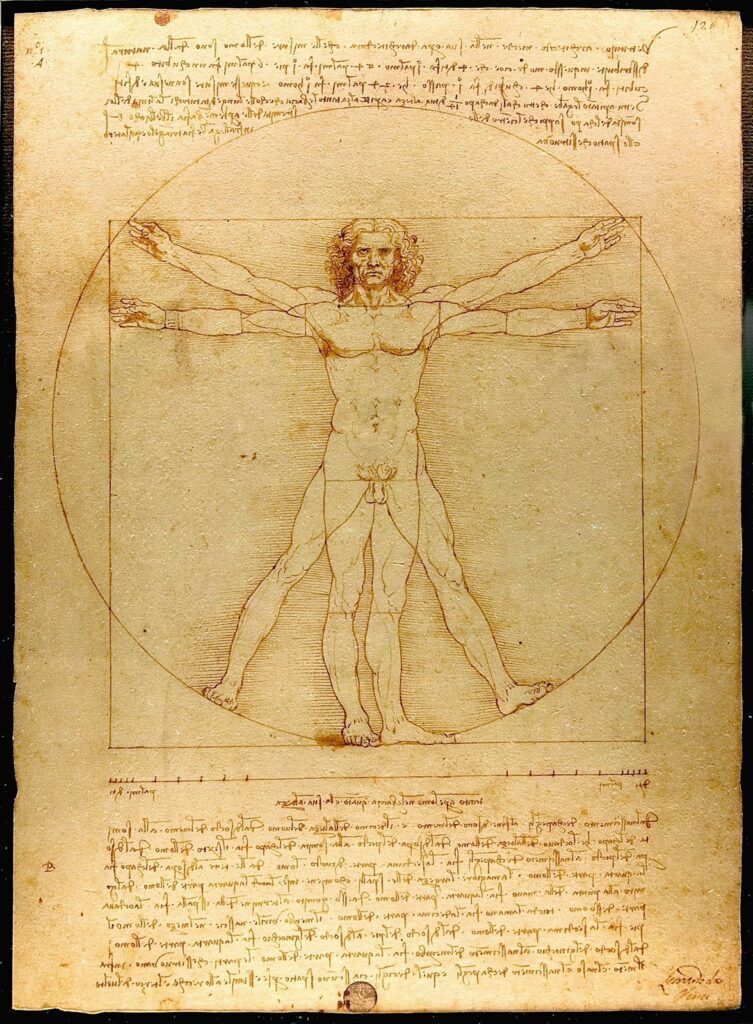
Vitruvin Man : The “Magic formula” of design.
You must have seen the drawing of a man standing between a circle and a square—that is The Vitruvian Man. This is not just art; it is the essence of human body geometry. Vinci proved that:
● A person’s arm span is equal to their total height.
● Every part of the body follows a perfect mathematical ratio.
For a NIFT or NID aspirant, this work is a masterclass. It teaches that without understanding proportion and balance, no design can ever be perfect. Vinci showed that the human body is nature’s most perfect design.
A:19 When Art Met Anatomy: Da Vinci’s Revolutionary Study of the Human Body
Vinci’s Real Contribution to Biology
Vinci didn’t just observe biology—he visualized it. He was the first to explain how heart valves function and how blood flows through the body.
- Mechanical Understanding: He viewed the body like a machine, believing bones act as levers and muscles as cords.
- Cross-Sectional Views: He introduced the concept of “exploded views,” where parts are shown separately—something widely used today in modern engineering and design.
- Embryology: He was the first to accurately draw the position of a fetus inside the womb.
Why is Da Vinchi important for design students
Today, students preparing for NIFT or other design entrance exams often focus only on sketching. But da Vinci teaches us that observation is the real skill. Until you understand the structure and function of something, you cannot truly bring it onto paper with feeling. Design is not just about looking beautiful on the surface; it is about problem-solving and understanding—exactly how Vinci understood biology through the lens of design.
Conclution
A:19 When Art Met Anatomy: Da Vinci’s Revolutionary Study of the Human Body
Leonardo da Vinci showed the world that art and science are not separate. His study of human anatomy made him a legend because he didn’t just create something “beautiful”—he searched for the answers to “why” and “how.” Remember, the difference between an ordinary artist and a visionary designer lies in curiosity and observation.
If you also want to bring that depth into your creative journey and dream of cracking design entrance exams, you need the right guidance. At https://flypen.in/, we don’t just teach sketching—we teach you how to think like a designer.
Ready to start your design journey? If you are preparing for NIFT, NID, CEED, or UCEED, Flypen’s expert coaching will guide you at every step.